
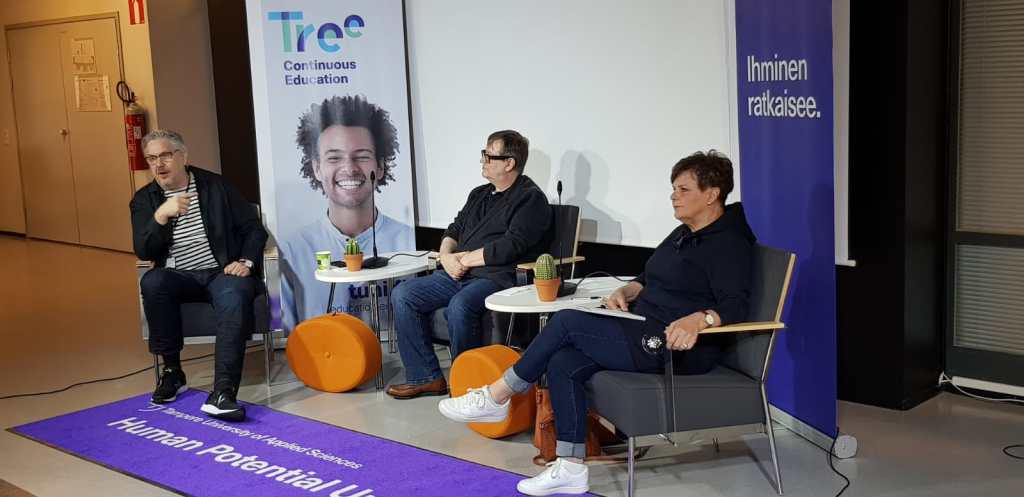
In a recent conversation about the Teacher Trust program with a teacher, she informed me that most educators think that they are ‘not allowed’ to make some of the changes mentioned in the program.
Pasi Sahlberg also mentioned that he was often contacted by principals wanting to make changes to the practices that had been failing them for decades, but they were ‘not sure who they had to ask’ for permission to implement them. Pasi’s response is always, “You are the principal: you don’t need to ask anyone. Do what is right.”
A recent visit to Croydon Community school was an excellent reminder that programs far more ‘progressive’ than those of Teacher Trust can be implemented in Australian schools with great success. Principal Bronwyn Harcourt summed up the reasons for change in this phrase:
“If a teacher keeps doing the same thing over and over and the student doesn’t improve, who is really the slow learner?”
During my visits to Finland and while researching the Testing 3,2,1… book, I made it my goal as I talked to dozens of educators and read hundreds of research papers, books and reports, to find the mythical reason as to why elements of this amazing education system I was witnessing, could not be used in Australia. To this day, I still have some people suggest that it is pointless to look at the Finnish system. But oddly, they have all got a different reason, and I’ve never heard it from anyone who has spent time in their schools. From, “Their society is structured differently…” (What on earth does this mean!?) to “They pay an unreasonably high tax rate”. (I investigated this one and found that my teacher colleagues their paid very similar rates of tax, and more importantly, Australia was spending more per student on its education system than Finland).
What I did find as I went through the neuroscience and research is that when I looked in the practices common in Finland (and there is no one way of doing things there as teachers are trusted to know what is best for their students) is that what the Finnish are doing is firmly supported by research and neuroscience – hence the decades of impressive outcomes. When I did the same with my own practices in Australia, I was disappointed to find that there was little of anything to back them up. In fact much of what we were doing was there because that’s the way we’ve always done it, and much of it was doing more harm than good.
I left Finland excited to be able to announce (and with a book containing the neuroscience details to help) that we could make some changes immediately that would make school life immensely more satisfying for both students and teachers. Reviews for the book were excellent, but it was obvious that more was needed. A good friend and colleague in teacher education in Finland suggested we work together, with his teaching university assisting in the creation and delivery of a program for Australian schools. Teacher Trust was born, just as the media began to really take notice of the education crisis in Australia.
We began working with a cluster of primary schools around Orange in New South Wales. It was the first professional development day I’ve ever been involved with where the participants asked if we could extend the session – the last hour is the real time link with a panel from the Finnish university. A couple of these schools changed their timetables to give students a 15-minute break every 45 minutes. Some parent resistance at one school was quickly withdrawn as they saw the improvements in their children. Teachers and students immediately reported increased productivity, focus, enthusiasm, and outcomes in line with what neuroscience suggests should be happening. It is one practice which is common right across Finland and they were shocked to find we were not doing it. I have used the same practice with secondary students during a 100-minute English class with excellent results.
If memorization is your goal, research tells us that repeating the learned material in the session immediately after the 15-minute break will lead to better results than if you were to have moved onto something else, or even continued doing the same thing without the break. Neuroscience tells us that the brain will ‘print’ over the first learnings with subsequent ones if there is no break or make them ‘concrete’ if you return to them after the break.
I found that the improvements in the students’ attitude and motivation alone were substantial, probably because we were now learning in a manner which considered the neuroscience – even if they are not aware of this.
What else are we aiming for with Teacher Trust? Intrinsic motivation. Rather than the school having a curriculum that it imposes onto the students and then tests to see if they have memorized it, the goal becomes to turn it around and create students who see what they are studying as something belonging to them and being done because they want to do it because it is worth doing.
This is perhaps the biggest secret to the post-industrial model of education. Once the student owns the material and motivation is intrinsic, engagement becomes inspiration, application becomes fascination and passion. Stress is almost completely removed as the teacher and students become collaborators. The teacher is no longer a part time policeman, and the student is no longer a passive recipient.
There is not sufficient space to detail how this is achieved, but every step towards it pays off immensely.
Autonomy and responsibility/self-regulation. In Australia, where almost all mass manufacturing has been moved offshore, the idea of everyone doing the same things at the same time, in the same manner, is redundant. In a recent education round-table, a representative from the SEEK employment agency said that the thing employers said was lacking in young new-employees was adaptability and initiative. Neither are encouraged in our education system, yet in the modern working world they are key traits.
In some ways these tie in with the intrinsic motivation mentioned earlier. I was impressed that the Finnish educator can tell the student that everything being done in the school is to make the education experience more enjoyable and successful. This attitude keeps wellbeing at the forefront. It is understood that without wellbeing there is no learning. And when we aim for enjoyment of learning, the neuroscience tells us that the efficiency of the learning process is increased. Once again, this is an aspect almost completely ignored by many education systems. Indeed, I’ve heard many an educator say what Alfie Kohn describes as BGTUI or “better get used to it” to rationalise pointless, unpleasant, and even harmful things done to children on the grounds that this will prepare them for the pointless, unpleasant or harmful things they may encounter later.
Again, there isn’t space here to detail how it is done, but every step towards autonomy and responsibility is one more step towards the skills required in the real world. When Finnish teachers were surveyed on what it would take for them to leave the profession, loss of the autonomy they have was ahead of wages or other conditions. In the current education environment, teacher autonomy has eroded almost completely and its restoration is the single factor that can have the greatest impact on keeping teachers in the profession.
None of the above are ‘progressive’ or ‘alternative’ (though sadly they are a long way from everyday practice in Australia), but they are practices that have an immense influence on wellbeing, stress, motivation, enjoyment of school and learning, and, lastly, grades and results. And none of them require ‘permission’ from anyone to implement.
As Pasi put it: “It’s the right thing to do.”
 Michael Lawrence and Dr. Fabio D'Agostin | Creating Schools...
Leave a comment